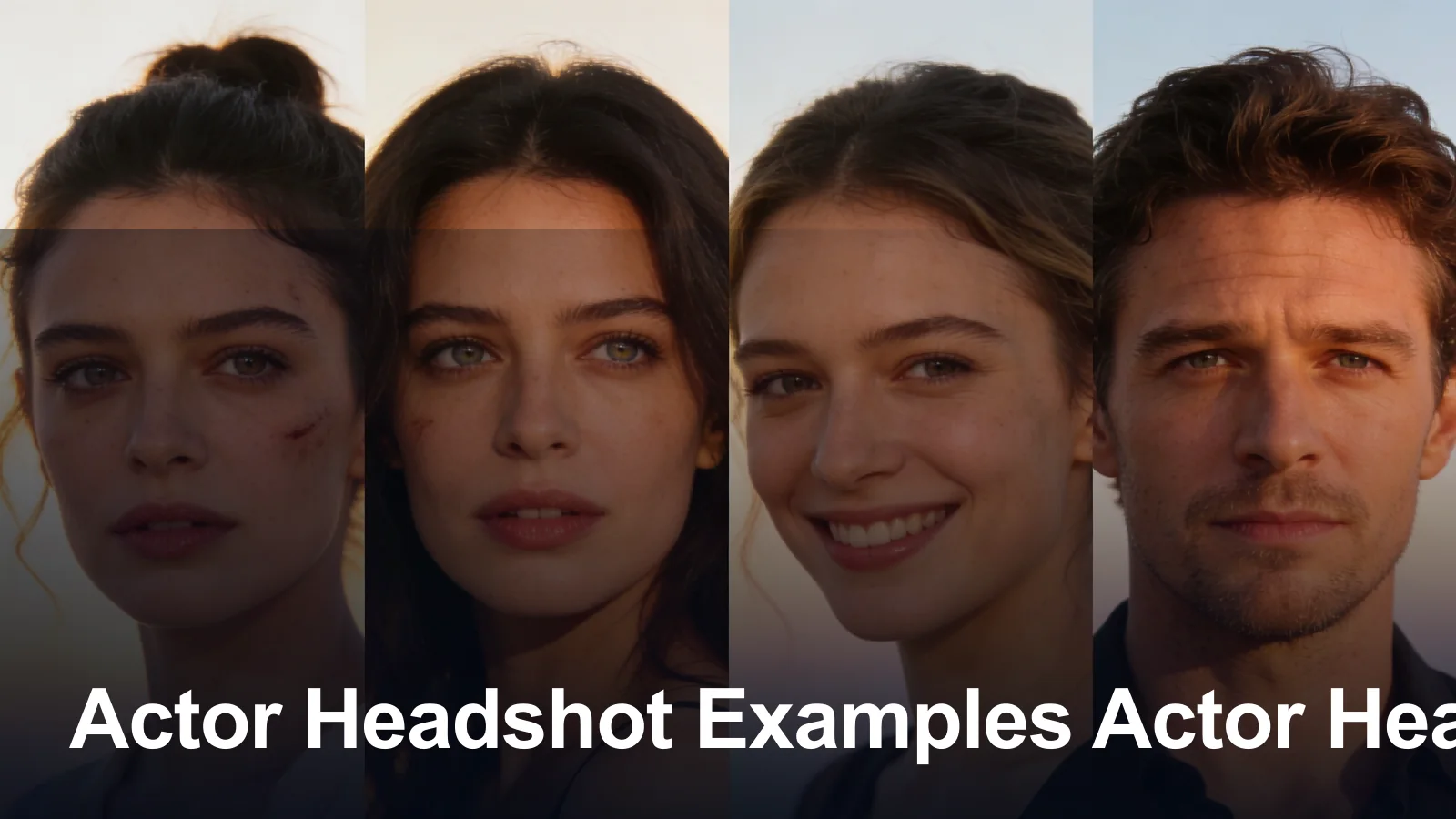
Looking at actor headshot examples is useful for the same reason that looking at demo reels is useful: once you see enough strong work, patterns become obvious. The best actor headshot examples are not just attractive portraits. They communicate type, feel current, and make it easier for a casting director to place the actor in a role within a few seconds.
That is why this article is not a gallery for inspiration alone. It is a framework for judging what works. If you already know the basics of theatrical versus commercial positioning, pair this with professional acting headshots. If you want example-driven pattern recognition first, start here.
What actor headshot examples are supposed to prove
Strong actor headshot examples are doing more than showing a face. They are proving that the actor can be marketed clearly.
The headshot should answer questions like:
- what type could this person plausibly play?
- does the expression feel real?
- does the styling fit the submission lane?
- does the image look current enough to trust?
That is why acting headshot examples should be judged on clarity, not just beauty. A technically polished portrait that says nothing specific about the actor is weaker than a simpler shot that communicates type immediately.
Actor headshot examples by submission type
One of the fastest ways to understand this category is to sort actor headshot examples by where they would actually be used.
| Submission lane | What strong examples usually show | What weak examples usually show |
|---|---|---|
| Commercial | open face, warmer light, approachable expression, easy trust | forced smile, ad-like gloss, generic friendliness |
| Theatrical | depth, specificity, calmer or more intense expression, dimensional light | exaggerated seriousness, over-styled mood, old-school drama cliches |
| Comedy / character | spark in the eyes, strong personality, controlled variety | mugging, obvious "funny face," novelty over credibility |
| Youthful / contemporary TV | clean styling, current wardrobe, direct energy | dated wardrobe, heavily retouched skin, disconnected expression |
This table matters because most weak submissions come from misalignment. The actor sends a bright commercial smile to a dramatic casting office, or tries to look "serious" for everything and loses warmth altogether.
The best actor headshot examples share the same fundamentals
Even though styles change, the best actor headshot examples almost always share a short list of fundamentals.
The eyes look engaged
Flat eyes kill headshots fast. Casting directors do not need you to stare intensely at the lens, but they do need to feel present contact.
The styling supports type instead of fighting it
Wardrobe, grooming, and background should reinforce the lane. That does not mean costume. It means choices that nudge the image toward the roles you are actually submitting for.
The crop stays focused on the face
Most strong actor headshot examples are tight enough that the face dominates, but not so tight that the image feels cramped. If you want to study how pose and crop work together, the guide on professional headshot poses helps.
The image still looks like a real person
When skin becomes too smooth, contrast too dramatic, or styling too polished, the actor disappears and the "photo" starts doing all the work. That is almost always a losing trade.
Commercial actor headshot examples vs theatrical actor headshot examples
The difference between commercial and theatrical shots is still the most important split in the category.
Commercial actor headshot examples usually work because they feel:
- bright enough to trust quickly
- warm but not fake
- contemporary
- usable for ads, lighter TV, branded content, and relatable roles
Theatrical actor headshot examples usually work because they feel:
- more specific
- more grounded
- less smile-driven
- better suited to drama, stage, independent film, and roles with more weight
Actors often make the mistake of treating one of these lanes as "the real headshot" and the other as optional. In practice, most working actors benefit from having both. If you do not, you end up submitting one emotional signal into every room.
What weak actor headshot examples reveal immediately
Sometimes it is easier to learn from failure. Weak actor headshot examples usually reveal the same problems over and over.
The actor is performing professionalism
This is more common in people crossing over from corporate photography. The image looks polished, but it feels like a business portrait rather than an acting submission.
The wardrobe is too literal
A leather jacket does not automatically create edge. A blazer does not automatically create authority. Good headshots suggest type; they do not costume it too hard.
The retouching is obvious
Heavy skin cleanup, sharpened eyes, and glow effects make the actor look less castable, not more.
The photo looks old
Outdated styling, an old haircut, or a mismatch with the actor's current face creates friction right away. Casting offices notice faster than actors think they do.
If you want a general baseline for comparing portrait quality, professional headshot examples is useful here. It is broader than acting, but the evaluation logic still holds.
Actress headshot examples and actor headshot examples follow the same rules
People search separately for actress headshot examples, but the strongest answer is that the underlying rules barely change. Strong examples still rely on clarity, current styling, believable expression, and type signal.
What may change:
- makeup restraint matters more because heavy makeup reads fast on camera
- neckline and wardrobe texture can change how quickly the image reads
- hair direction affects perceived age, softness, and type
What does not change:
- the eyes must be alive
- the crop must still prioritize the face
- the photo must still resemble the actor today
- the shot must still fit the intended lane
That is why it is usually more useful to study actress headshot examples by casting lane than by gender label alone.
How to benchmark your own shots against examples
Once you have a few strong actor headshot examples in front of you, stop asking whether your shot is "good" and start asking narrower questions:
- would this read as commercial or theatrical immediately?
- does the expression feel connected or posed?
- does the wardrobe support the type I am selling?
- does the image still look current for my actual market?
- would this hold up next to working actors in my submission lane?
That last question is the one that matters. Compare your image against real category standards, not just against your previous photo.
If your issue is setup rather than selection, the wardrobe guide what to wear for professional headshots helps narrow clothing choices, and how to take a professional headshot at home covers the source-image basics.
Using AI to test actor headshot examples between shoots
Not every actor needs to book a photographer every time a haircut changes, a lane shifts, or a quick update is needed. Sometimes you need to test direction first.
That is where an AI preview workflow can help. With Photocvia, you can upload a clear current photo, compare different headshot directions, and see whether the result looks close enough to strong actor headshot examples before you pay to keep the HD version.
This is especially useful when:
- you want to test commercial versus theatrical tone
- you need a cleaner stopgap image before a full shoot
- you are comparing wardrobe and crop direction
- you want a more current image while planning a proper session
It is not a replacement for every photographer-led session. It is a fast way to pressure-test your presentation between shoots. If the preview holds up against the example patterns in this article, it may be good enough for the immediate use case. For cost details, see the pricing page.
FAQ
What makes actor headshot examples actually useful?
The best actor headshot examples show how casting type, expression, styling, and crop work together. They are useful when they help you evaluate your own image against real submission standards.
Should actors have separate commercial and theatrical headshots?
Usually yes. Commercial and theatrical submissions ask for different emotional signals, and one image rarely does both equally well.
Are actress headshot examples different from actor headshot examples?
Not in the core rules. Actress headshot examples still need believable expression, current styling, and strong type clarity. The differences are usually in grooming and wardrobe nuance, not in the evaluation framework.
What is the most common mistake in acting headshot examples?
Usually the photo looks too corporate, too retouched, or too disconnected from the actor's real casting lane.
Can AI create a usable acting headshot between shoots?
Yes, if the source image is strong and the result stays believable. The right use case is testing or bridging between sessions, not blindly replacing judgment.
Final Takeaway
The best actor headshot examples are the ones that make casting easier. They communicate lane, feel current, and keep the actor recognizable and specific without forcing the performance inside the still image.
If you want to test your own shot against that standard, generate a preview on Photocvia, compare it with the other English guides, and keep only the version that would hold up beside working actors in your target lane.